

I am currently playing a reckless Bard in a Dungeons and Dragons campaign. He’s his troupe’s resident stuntman and fight choreographer so in combat he believes he acts more like a fighter and rushes to the front line to defend his team.
I roll a lot of death saving throws.
If you are unfamiliar without 5th edition Dungeons and Dragons rules (or just to get us all on the same page), if your character drops to 0 hit points then on each of your next turns you need to make a “death saving throw”. Once you accumulate 3 successes, you are stable, but still unconscious. 3 failures means your character has officially died.
A “success” is defined as a 10-19 on a 20-sided die (d20). A “failure” is 2-9. A natural 1, typically called a “critical fail” counts as two failures. A “critical success” natural 20 means you regain 1 hit point, and come back from the dead, conscious and ready to keep fighting.
So what is the chance of survival, once you have dropped to 0 hp?
Probabilities of Success and Failure
This is certainly not a new question, and has been addressed several times online. This is mostly just an exercise to learn and practice the maths involved.
First of all, lets convert the probabilities above into some numbers we can work with. Since there are 20 possible numbers on the die, each individual number has a 5% chance of showing up. Thus, every time you roll a death saving throw, there is a 5% chance of a 1, and a 5% chance of a 20. A regular fail is a 2-9, which is 8 outcomes out of 20 or 40%. A success is a 10-19, 10 outcomes out of 20, so 50%.
| Outcome | d20 | Chance % |
|---|---|---|
| Revival | 20 | 5 % |
| One Success | 10 – 19 | 50 % |
| One Failure | 2 – 9 | 40 % |
| Two Failures | 1 | 5 % |
However, this only lets us know how likely each individual result on the dice result is, not the total chances of success. Remember that we’re rolling until we acquire 3 successes or 3 failures, and the different outcomes move the needle in different ways. What we have is a situation where there are several potential states, and a certain percentage chance of moving from one particular state to another. We need to use a Markov Chain.
In the simplest terms, a Markov Chain is a matrix that models how likely it is to move from one state (rows) to another (columns). Let’s start by defining our start and end conditions.
- 0 Hp – this is where the whole process starts. You were up and fighting, then you were defeated and landed here.
- Stable – this is the “good” end condition. Once you get three successes, you are stable and no longer have to roll death saves.
- Dead – this is the “bad” end condition. Once you get to three failures, you are permanently out of the game and the only thing you’ll be rolling are stats for a new character.
- Revived – this is the best end condition. You stop rolling death saves and get back up with 1 hit point. Of course… if you take another hit you’ll go back to 0 HP and start all over.
Now Markov Chains have no memory, meaning they only care about the probability at the current time. If you’re sitting in a particular state at round 3, it doesn’t matter what path you took to get there. Our problem does care about the history, however, so we simply have to build that in to our intermediary states. I’ll be using the notation (s, f) where the first number represents the number of accumulated successes (before this roll), and the second represents the number of accumulated failures.
- (0, 1)
- (1, 0)
- (1, 1)
- (1, 2)
- (0, 2)
- (2, 0)
- (2, 1)
- (2, 2)
(0, 0) is unnecessary – this correlates to our initial state of 0 HP. Similarly, any pairing with 3 or more failures correlates to Dead and 3 or more successes correlates to Stable.
Now, to begin constructing our Markov Chain, we apply the probabilities from earlier to figure out the probability of moving from one state to another.
First of all, starting from 0 HP – we have a 5% chance of immediately being Revived (on a roll of 20 – very lucky!); a 50% of moving to the state (1, 0); a 40% of moving to the state (0, 1); and a 5% of moving to the state (0, 2).
The end states are also referred to as “absorbing states” because once you end in one of those states, you stop moving anywhere. When we construct our matrix, we’ll represent that by showing them having a 100% chance of transitioning to the same state:
- Dead: 100% Chance of staying Dead
- Stable: 100% Chance of staying Stable
For the “Revived” state, we have two options. For now, we’re going to say you have a 100% Chance of staying Revived. However, it is just as valid to say that it has a certain chance of transitioning to 0 HP, and a complementary chance of staying revived. That is too difficult to predict, though, so we’ll ignore that case for now.
For each of the transitional states, we’ll use the following rules to construct the probabilities:
- There is always a 5% chance of becoming revived (even if you have 2 failures)
- If you have 0 or 1 success, there is a 50% chance of moving to the state with one more success and the same number of failures.
- If you have 2 successes, there is a 50% chance of becoming Stable (regardless of the number of failures)
- If you have 0 failures, there is a 40% chance of having 1 failure and a 5% chance of having 2 failures (each with the same number of successes)
- If you have 1 failure, there is a 40% chance of having 2 failures (with the same number of successes) and a 5% chance of being Dead.
- If you have 2 failures, there is a 45% chance of being Dead (regardless if you get 1 or 2 failures. There is no Extra-Dead).
Below is a screenshot of the completed matrix, created in Excel. The colors correspond to the different rolls:
- Light Orange: 1 (5%)
- Dark Orange: 2-9 (5%)
- Medium Orange: 1-9 (45%)
- Light Blue: 10-19 (50%)
- Dark Blue: 20 (5%)
- Dark Green: Absorbing States (100%)

So, that’s cool. We started off wanting the probability of surviving your death saving throws, and now we have a 12×12 grid of numbers! So how do we use this matrix to actually answer the question?
Working It Out
Now that we have a matrix, we are going to need to put it to work. And to do that, we’re going to need ONE MORE MATRIX! The reason is this – our Markov Chain matrix above shows us the probabilities of transitioning from one state to another, which holds true at any point in time. What we want is a matrix holding the current probability of being in a particular state at the current time. As such, it only needs to have one column, and a separate row to hold each state. Initially, we have a 100% chance of being in the state “0 HP” (as we have just dropped out of combat on the previous turn). We also have a 0% chance of being in any other state, so our matrix looks like this:

The last step is to do some matrix multiplication to find the probabilities for each successive round.
In Excel, the process looks like this: select the entire column next to the values for Round 0 (C16:C27). With the first cell highlighted, type in the array formula (explained below). Instead of pressing ‘Enter’ as usual, press ‘Control-Shift-Enter’ to make the formula calculate each cell.
The formula itself is:
= TRANSPOSE(MMULT(TRANSPOSE(B16:B27),$B$2:$M$13))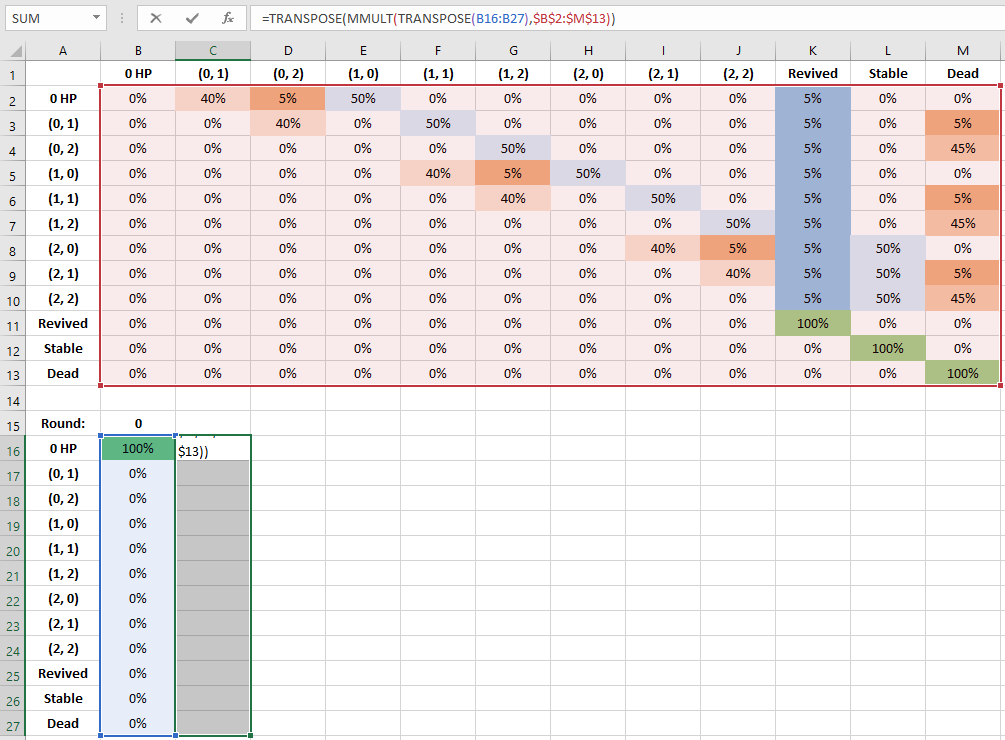

Note: The reason for the two “Transpose” functions in the formula above is that the first matrix should technically be a row – I just prefer how the column looks in this instance.
Basically this formula does the following:
- Flip the state matrix (blue) to horizontal
- Multiply the first cell of this new matrix by each value in the first column of the transition matrix (red) and calculate the sum – store this in the first cell of the result matrix.
- Flip the result matrix back to vertical (to display properly and to set up future iterations of this formula)
The first step is simple, as it just replicates the first row of data – 40% chance of being in state (0, 1); 5% chance of (0, 2); 50% chance of (1, 0); and 5% chance of being Revived.
Luckily, now that this step is done, we can grab that little square in the lower right of the range and drag to the right for as many rounds as we want.

The Final Result

Above is the final set of calculations for the probability of being in each state, based on the round. Note, the numbers in each column may not exactly add up to 100% due to rounding and not displaying decimal points. The underlying math all makes sense.
- Overall, there is only a 40% chance of being absorbed into the “Dead” state.
- Just over 40% of the time, your character will stabilize and wait until they can be revived by a team member (or wakes up with 1 hit point 1d4 hours later).
- Just under 20% of the time, your character will bounce back into the fight with 1 hit point.
- Roughly 25% of the time, you’ll be in that awful situation of having 2 successes and 2 failures. Your next roll determines your fate. You know the odds are slightly in favor of you stabilizing, and you may even rejoin the battle – but no amount of statistics can tell you what that one next roll will be…
Extra Credit
The numbers in the table above show the total probability of being in a certain state by the specified round. That’s why the “Revived” state has values of 5%, 10%, 14%, 17%, and finally 18% for the rest. The results are cumulative.
If instead, you wanted to see the odds of reaching a certain state at a given round, you just need to adjust the probabilities of your absorbing states from 100% to 0% – this takes them out of the calculation for the next round.

Now we see that of the 18% total chance of jumping back to your feet, there’s a 5% chance of getting up in round 1, 5% in round 2, 4% in round 3, 3% in round 4, and 1% in round 5.
We can also see that, in terms of the three absorbing states, the most likely outcome is that you’ll stabilize in round 4. This will happen 17% o f the time. The second most likely outcome is you’ll die in round 4. The outcomes are ranked below:
- 17% – Stabilize in Round 4
- 14% – Die in Round 4
- 13% – Stabilize in Round 3
- 12% – Stabilize in Round 5
- 11% – Die in Round 3
- 11% – Die in Round 5
- 5% – Revive in Round 1
- 5% – Revive in Round 2
- 4% – Die in Round 2
- 4% – Revive in Round 3
- 3% – Revive in Round 4
- 1% – Revive in Round 5
By adding together the probabilities of these states per column, we can also see the probabilities of getting a “final answer” of sorts in each round.
- 34% – Round 4
- 28% – Round 3
- 24% – Round 5
- 9% – Round 2
- 5% – Round 1
We can also see that on average, your death saving thows will last approximately 3.6 rounds. This also means your teammates will probably be okay for 2 rounds while you try to either neutralize the threat, or get near them to pour a healing potion into their stupid face.
However, these calculations don’t take into account that if you take any damage while you are unconscious, you receive an automatic failure on your death saving throw. Two if it’s from a critical hit. This could be from a monster or your idiot wizard casting fireball over your corpse. Of course, if you the damage you take while unconscious is greater than your maximum hit points, you are just insta-dead. Sorry.
 Stochastic Otter